Home improvement loan calculator: Apply in 3min | Response within 24h
Home improvement loan
Carrying out work on your home is often necessary, but it can also represent a significant financial commitment. Energy renovation, bringing installations up to standard, improving comfort or simply refreshing a property — these projects can involve substantial costs.
Need urgent credit? Call us directly.
A Crefilux advisor can help you quickly review your situation, tell you what information to prepare and move your application forward.
A home improvement loan allows you to finance these expenses without immediately using all your savings, even for major renovation projects. Here are the key points to understand how it works, its advantages and the situations in which it may be relevant.
What is a home improvement loan?
A home improvement loan is a type of consumer credit designed to finance renovation or improvement work in a property, whether it is a primary residence, a second home or a rental property. It allows you to cover all or part of the costs associated with the work over a predetermined period, with fixed monthly payments known from the moment the loan is taken out.
Example of a home improvement loan
To better understand how a home improvement loan works, let’s take a practical example. Suppose you want to finance renovation work costing €30,000. You choose to repay this amount over 60 months, or five years.
In this case, the financing could look like this:
| Home improvement loan elements | Values |
|---|---|
| Amount borrowed | €30,000 |
| Repayment period | 60 months |
| Estimated monthly payment | €557 |
| Total cost of the loan | €3,420 |
How should these figures be interpreted?
The monthly payment is the amount you repay each month. It includes:
- a portion that repays the borrowed capital
- a portion of interest, calculated according to the interest rate and the loan duration
The total cost of the loan represents the total amount of interest paid over the entire duration of the loan. In other words, it is the cost of financing in addition to the borrowed capital.
In this example, borrowing €30,000 over 60 months would cost €3,420 in interest paid to the lender, spread over five years. You can run a home improvement loan simulation at any time using the simulator at the top of this page to estimate your own project.

What are the advantages and disadvantages of a home improvement loan?
If you are planning renovation or improvement work on your property in Luxembourg, one of the most effective solutions is to contact a credit broker to arrange financing. This option can be particularly advantageous when the financing solution is tailored to your project.
- Advantages in brief: The main advantage of a home improvement loan is that it allows you to complete your renovation projects without immediately exhausting your savings. By borrowing, you obtain the liquidity needed to carry out the work while keeping your personal savings intact. Repayments are spread over time, and you can choose a repayment period that fits your budget and provides comfortable monthly payments. A home improvement loan therefore makes it possible to enhance the comfort of your living environment and improve your property.
- Disadvantages in brief: There is always a downside. Borrowing money means committing to repay the full amount borrowed. In addition to the capital, interest must also be repaid, and this may vary depending on the bank, your personal financial situation and the characteristics of the loan (type of credit, duration and amount borrowed). It is therefore essential to borrow within your repayment capacity in order to avoid financial difficulties later.
| Advantages of a home improvement loan | Disadvantages of a home improvement loan |
|---|---|
|
|
What types of work can be financed with a home improvement loan?
In most cases, a home improvement loan responds to a very concrete need — sometimes urgent, sometimes carefully planned, but almost always linked to everyday realities: a home that evolves, an unexpected issue that must be addressed, or a project that can no longer be postponed. Understanding when a home improvement loan is truly useful helps you make a more confident decision, without guilt or improvisation.
- Dealing with urgent and unexpected repairs: Some situations leave little room for choice: a leaking roof, a heating system that breaks down in the middle of winter, faulty electrical wiring or water damage discovered too late. These problems rarely occur at the “right moment” and require quick action. In such cases, a home improvement loan allows you to respond immediately, secure your home and spread the cost over time rather than relying entirely on savings that may be insufficient or already allocated elsewhere.
- Renovating or improving your home over time: Other projects are more planned and long-term: interior renovation, bringing installations up to standard, improving comfort or increasing energy efficiency. These works are not always urgent, but they contribute significantly to quality of life and the long-term value of the property. A renovation loan allows you to move forward step by step without indefinitely postponing an important project due to a lack of immediate funds.
- Managing outdoor projects that are often underestimated: Outdoor areas are often overlooked — until they become a problem. A garden that becomes difficult to maintain, trees that grow out of control after an exceptional season, fencing that needs replacing, access areas that need securing or a terrace that requires renovation. These projects can arise unexpectedly and sometimes involve significant costs. A home improvement loan makes it possible to address these needs without turning a one-off project into financial stress.
- Handling mandatory work in shared properties: In co-owned buildings, some decisions are not entirely up to the individual owner. Work approved during a co-owners’ meeting may require substantial financial contributions: façade renovation, roof repairs, elevators or collective heating systems. In these situations, a home improvement loan becomes a practical financial tool. It allows you to absorb an imposed expense without destabilising your household budget.
- Completing a property purchase without reconsidering everything: After buying a property, it is common to realise that certain works are needed sooner than expected. What seemed acceptable during the viewing may become a priority once you move in. A home improvement loan can help finalise the project without having to rethink the entire purchase or compromise other financial priorities.
- Adapting your home to a new stage of life: Finally, some projects arise from personal changes: the arrival of a child, remote work becoming permanent, or the need to adapt the home for a family member — or for yourself over time. In these situations, a home improvement loan is not simply a comfort expense. It becomes a way to adapt your living environment to your evolving needs.
Eligibility criteria for a home improvement loan
To borrow money for renovation work in Luxembourg, certain conditions must be met and required by banks. As part of a home improvement loan application, you will need to provide several supporting documents. You must present a valid proof of identity so the lender can confirm that you are a Luxembourg resident (or a cross-border worker) and that you meet the legal minimum age for borrowing, which is 18 years old.
To obtain a home improvement loan, you must also not be registered as a bad payer with the Central Bank. Individuals listed as such are subject to banking restrictions and cannot obtain credit until their financial situation has been regularised.
To prevent over-indebtedness, your borrowing capacity will also be assessed. For this purpose, proof of income will be required. If you are employed, you can provide payslips from the last three months. If you are self-employed, you may be asked for a copy of your most recent tax assessment. If you currently have other loans, you will also need to provide recent bank statements or copies of existing credit agreements.
How to choose the best loan for your renovation project
When you plan to finance renovation work, it is important to choose a type of credit that truly matches your project. Two main categories exist: a purpose-linked home improvement loan and a personal loan. Both are forms of consumer credit that can be used to finance renovation work in Luxembourg and provide legal protections for the borrower (pre-contractual information, withdrawal rights, early repayment options, etc.).
A purpose-linked loan for renovation work
A purpose-linked loan is a credit specifically dedicated to financing your renovation project. This means the borrowed amount is directly tied to the work being carried out and can only be used for the expenses declared to the lender.
This system provides several practical advantages:
- Direct link with the project: the loan agreement specifies the renovation work being financed.
- Protection if the project is not carried out: if the work ultimately does not take place, the loan may be automatically cancelled without excessive cost.
- Clear documentation: the bank or financial institution will request quotes or invoices to ensure the funds are used for the declared work. This requirement is also a guarantee of transparency for both borrower and lender.
Examples where a purpose-linked loan is particularly appropriate
- You have obtained detailed quotes for an energy renovation project and want the financing to be dedicated exclusively to this work.
- You must carry out urgent repairs (electrical installation, waterproofing repairs) and want the loan clearly associated with these works.
- You are managing a structured renovation project involving several contractors and want the financing to follow the different stages of the work.
In these situations, a purpose-linked home improvement loan provides maximum visibility regarding the use of the funds and ensures better alignment between the borrowed amount and the actual expenses.
A personal loan for renovation work (without supporting documents)
A personal loan is also a form of consumer credit that can be used for renovation work, but it is not linked to a specific purpose. This means you receive a lump sum that you can use as you wish — for renovation work, travel, a vehicle purchase or any other expense.
The advantages of this option include:
- No requirement to justify the expenses: you do not need to provide specific quotes or invoices.
- Greater flexibility: if you have several projects to finance (for example renovation work and another financial need), a personal loan allows you to combine them into a single credit.
- Simpler procedures: because the loan is not linked to a specific project, the application process may be faster and less administrative.
Examples where a personal loan may be suitable
- You have several projects in addition to your renovation work (new furniture, a vehicle purchase or temporary cash needs) and prefer a single loan.
- You want to retain full flexibility in how the funds are used rather than having a loan dedicated exclusively to renovation work.
How to choose between a purpose-linked renovation loan and a personal loan
- Choose a purpose-linked home improvement loan if your project is clearly defined and documented (accepted quotes, detailed renovation plan). Transparency and the direct link between the loan and the project can then be strong advantages.
- Choose a personal loan including renovation expenses if your needs are less specific or if you want to combine several financing needs into one loan.
In all cases, before signing any agreement in Luxembourg you will receive a standardised pre-contractual information document specifying the type of credit, the loan amount, the duration, the APR (Annual Percentage Rate), your withdrawal rights and your rights regarding early repayment or default.
How to optimise the interest rate of a home improvement loan
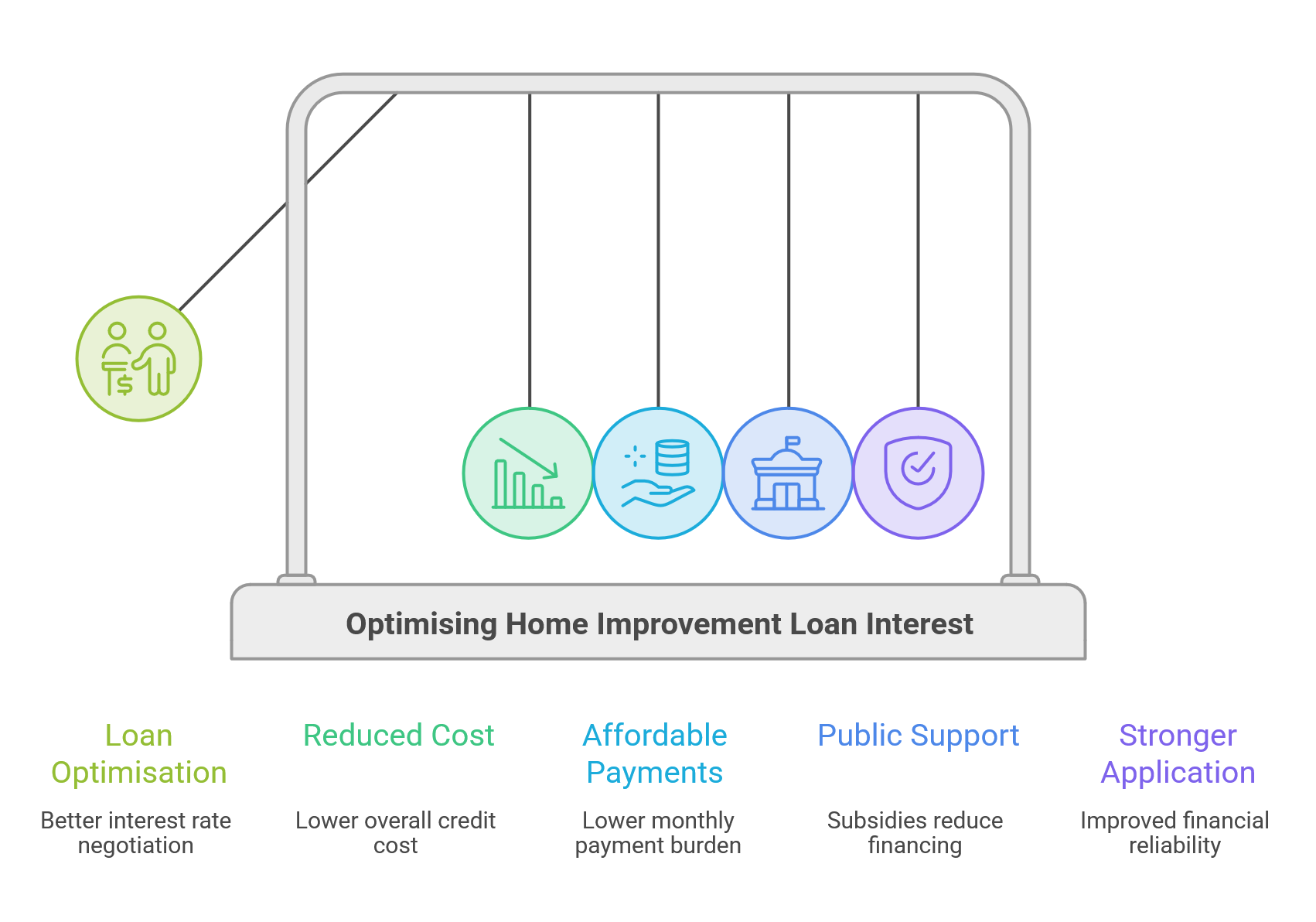
The interest rate is a key factor in a home improvement loan because it determines the amount of interest you will pay. However, it is also a parameter that can vary significantly from one loan to another and is often subject to negotiation between the lender and the borrower. Here are a few practical tips to help you negotiate a better rate.
Home improvement loans and financial support in Luxembourg
An optimised home improvement loan begins with an amount that is consistent with your repayment capacity. Borrowing too much increases the perceived risk for the bank. A longer loan duration reduces monthly payments but increases the total cost of the credit.
The objective is to find the right balance between affordable monthly payments and a controlled overall cost.
In Luxembourg, certain types of work — particularly energy renovation projects — may qualify for public financial support. The principle is simple: these subsidies can reduce the amount you actually need to finance, and therefore reduce the size of your home improvement loan.
Financial support varies depending on the type of work, but it often covers:
- Insulation (roof, façade, floors, attic spaces)
- Window replacement and improved airtightness
- More efficient heating systems (for example heat pumps or high-efficiency boilers, subject to conditions)
- Ventilation and other energy efficiency improvements
- Energy audits or advisory services in certain cases
To find out about available amounts, eligibility conditions, deadlines and administrative procedures, the main official sources are:
- Klimabonus (official website)
- lu (practical information and administrative procedures)
- Ministry of Housing and Spatial Planning (housing support programmes depending on the project)
Prepare your financial situation before applying
When a bank reviews a home improvement loan application, it does not focus solely on the renovation project itself. Several elements related to the borrower’s financial and professional situation are also taken into account.
Among the main factors considered are:
- Bank account management: avoiding frequent overdrafts and maintaining stable financial habits are positive signals for lenders.
- Overall debt level: existing loans are analysed to ensure the new monthly payment remains compatible with the household’s budget.
- Income stability over time: lenders look primarily at the regularity and continuity of income rather than the type of contract alone. A permanent contract is an advantage, but other situations may also be accepted if they are stable and consistent.
These factors help strengthen the perceived reliability of the home improvement loan application and may positively influence the conditions offered.
Working with a home improvement loan broker: a better prepared application
The role of a broker is not limited to comparing home improvement loan rates. They also help you present your project in a way that is coherent and aligned with the expectations of lenders in the Luxembourg market.
In practical terms, this support helps to:
- Structure the renovation project: clarify the type of work involved, its real cost, the required quotations and the consistency between the project and the requested loan amount.
- Prepare a strong financial application: identify the key aspects of your financial situation, anticipate potential concerns and present a clear and well-structured file to lenders.
Why choose Crefilux for your home improvement loan?
At Crefilux, our goal is to help you obtain the home improvement loan that best fits your project. Each application is analysed individually so that we can propose a financing solution tailored to your needs. By choosing our team to support your project, you benefit from professional guidance designed to help your renovation plans move forward with confidence.
Fast response: know within 24 hours if your loan is feasible
When you submit a home improvement loan request, you naturally want to know quickly whether your project is feasible. We fully understand this and provide an initial response as soon as possible. After submitting your online request, a Crefilux advisor will contact you within two hours to discuss your project.
Personalised financial guidance
The role of a broker is to act as an intermediary between you and the bank in order to facilitate negotiations in your favour. To do this effectively, we need a clear understanding of your real needs. Our specialists therefore take the time to discuss your project with you, ensure they fully understand your objectives and provide tailored guidance throughout the process. If you prefer, it is also possible to organise an in-person meeting, including for the final signing of the credit agreement.
Recognised expertise in Luxembourg credit brokerage
Crefilux has strong expertise in consumer credit and, more specifically, in home improvement loans. We know how to structure applications efficiently, negotiate competitive rates and facilitate the approval of your financing. With more than 40 years of experience supporting clients with financing projects, our team understands how to navigate the Luxembourg lending market and identify the most suitable solutions.
Submitting a home improvement loan request with Crefilux: the process
A home improvement loan request typically involves several steps. With Crefilux, the process usually begins with a free online loan simulation. This allows you to estimate your repayment capacity and understand the main parameters of your potential loan. Once this first step is completed, you can submit a loan request online, by phone, or by visiting one of our agencies to speak directly with a specialist. We will help refine your request based on your renovation project and your financial profile.
After your request is submitted, we analyse the feasibility of your project and provide a preliminary response as quickly as possible. We then gather the necessary documents in order to prepare and submit your application to our partner banks. The bank will issue a financing offer, which we help you review and negotiate if necessary. Once the terms are accepted and the contract is signed, the funds are released and made available for your renovation work. Please note that in the case of a purpose-linked home improvement loan, invoices or supporting documents may be required to confirm how the funds are used.
Mini-FAQ about home improvement loans
How much can you actually borrow with a home improvement loan?
At Crefilux, the amount you can borrow for your home improvement loan largely depends on your personal and financial situation. If you choose a specific type of loan, such as a purpose-linked home improvement loan, your borrowing capacity may differ from that of a non-purpose-linked personal loan. It is therefore important to review the details and speak with an advisor to determine the amount best suited to your situation.
Can I take out a home improvement loan if I already have other loans?
Yes, you can apply for a home improvement loan even if you already have existing loans. However, it is important to assess your borrowing capacity carefully in order to avoid repayment difficulties. Banks generally consider a debt ratio of around 35% of net monthly income as a reference threshold.
In some situations, it may also be possible to consolidate your existing loans and include your renovation financing in the same operation. Crefilux advisors are available to help you analyse all available options so you can make a well-informed decision.
Can a home improvement loan be repaid early?
Yes, a home improvement loan can be repaid early, either partially or in full. This means you may decide to settle your loan earlier than planned, for example if your financial situation improves or if you receive an unexpected sum of money.
In Luxembourg, early repayment is regulated under consumer credit law. Depending on the conditions of the contract, a limited compensation fee may apply, but it is strictly capped. This information is always clearly specified before the loan agreement is signed.
Can renovation work be included in an existing loan consolidation?
Yes, in certain situations it is possible to include a renovation budget within a loan consolidation. This option may be relevant if you already have several loans in progress and wish to finance renovation work without significantly increasing your monthly repayments.
By consolidating your existing loans together with the amount needed for the renovation into a single loan, it may be possible to simplify the management of your budget.
However, this option is not suitable for every situation. It depends in particular on your debt level, your income and the type of loans involved. A personalised assessment is therefore necessary to determine whether this solution is appropriate in your case.